
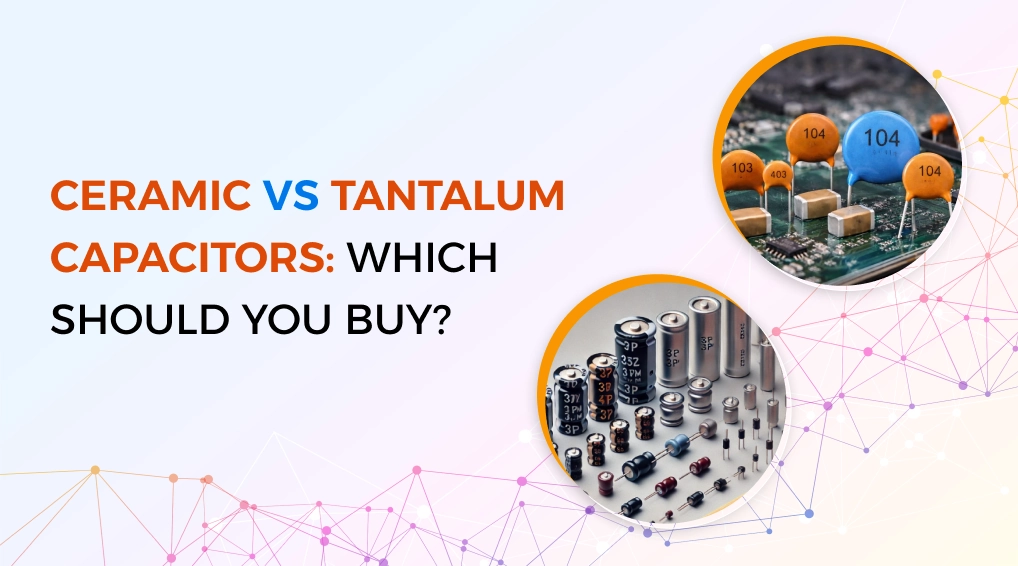
Choosing the right capacitor is important for any electronic design, repair job, or production requirement. Many buyers know they need a capacitor, but they are often unsure whether a ceramic capacitor or a tantalum capacitor is the better option.
Both are widely used in electronics, but they are not interchangeable in every situation. They differ in capacitance range, polarity, package type, stability, size, and typical applications, as well as in dielectric material, structure, and performance stability. Understanding the differences between tantalum and ceramic capacitors is crucial for optimal component selection in design decisions.
Choosing between ceramic and tantalum capacitors involves balancing stability, frequency response, and reliability based on the specific requirements of your circuit.
In this guide, we will explain the difference between ceramic and tantalum capacitors in simple terms so you can choose the right product for your PCB, prototype, repair work, or production order.
What Is a Multilayer Ceramic Capacitor?
A ceramic capacitor is a non-polarized capacitor made using ceramic material as the dielectric, also known as ceramic dielectric materials. These capacitors are commonly used in compact electronic circuits because they are small, affordable, and suitable for high-frequency applications.
Ceramic capacitors are found in consumer electronics, telecom devices, embedded systems, development boards, and compact PCB designs. They are especially common in decoupling, filtering, coupling, and noise suppression applications. Ceramic capacitors use ceramic capacitor dielectrics and are the most common surface-mount component.
Ceramic capacitors are non-polarized and can be used in both AC and DC circuits, making them robust against voltage surges.
One of their biggest advantages is that ceramic capacitors offer high-frequency performance, versatility, and are generally more cost-effective than tantalum capacitors. Ceramic capacitors typically come in a wide range of capacitance values and are significantly more affordable and available in ultra-small surface-mount packages for low-to-moderate capacitance values. Multilayer ceramic capacitors (MLCCs) are especially important in modern electronics, with the MLCC market expected to grow from $5 billion USD in 2018 to over $7 billion USD by 2023, highlighting their demand and profitability.
What Is a Tantalum Capacitor with High Capacitance Density?
A tantalum capacitor is a polarized capacitor known for stable capacitance and good volumetric efficiency. Tantalum capacitors are made using tantalum metal as the anode, which makes tantalum capacitors distinct in their construction and performance.
Tantalum capacitors are commonly used in power supply filtering, energy storage, timing circuits, portable electronics, industrial electronics, and applications where stable capacitance is important. In the manufacturing process, tantalum powder is pressed and sintered onto a tantalum wafer to form the anode, and a very thin dielectric layer of tantalum pentoxide is formed on the surface. This very thin dielectric layer (tantalum pentoxide) enables high capacitance density and high volumetric efficiency, making these capacitors suitable for applications demanding compact size and reliable performance.
They are available in both SMD tantalum and leaded tantalum versions, which makes them useful in both compact PCB layouts and through-hole designs. Tantalum wire is used for internal connections, ensuring reliable electrical connectivity within the device. The high volumetric efficiency and high capacitance density make tantalum capacitors ideal for compact electronics like smartphones and tablets, but they are generally more expensive than ceramic capacitors.
Ceramic vs Tantalum Capacitors: Main Difference
The biggest difference is simple:
- Ceramic capacitors are usually non-polarized and are excellent for high-frequency and general-purpose PCB use. Ceramic capacitors are robust against voltage surges and can be used in both AC and DC circuits.
- Tantalum capacitors are polarized and are often chosen when you need higher capacitance in a smaller package with stable performance. However, tantalum capacitors can fail catastrophically if connected in reverse, which is a critical failure mode to consider.
When comparing tantalum vs ceramic capacitors, both tantalum and ceramic capacitors have unique advantages and disadvantages, including differences in temperature stability and ESR. Tantalum capacitors generally have higher ESR than ceramic capacitors, which can be beneficial in some power supply designs to dampen oscillations and stabilize regulated rails. Ceramic capacitors offer high-frequency performance, low cost, and are non-polarized, but can suffer from DC bias effects.
This does not mean one is always better than the other. The right choice depends on your application.
When to Choose a Ceramic Capacitor
A ceramic capacitor is usually the better choice when:
- you need a small and cost-effective capacitor
- your circuit works at higher frequencies, where their excellent high-frequency performance and low ESR are crucial
- you need a non-polarized component
- you are working on signal filtering, noise reduction, or bypassing
- your design uses compact SMD footprints
For example, a 22 pF 50V ceramic capacitor in 0805 package is a good fit for compact PCB designs, signal-related circuits, and high-frequency applications where small capacitance values are required. Ceramic capacitors are ideal for RF circuits, resonant circuits, and applications requiring excellent frequency response and very low ESR.
Ceramic capacitors typically have ultra-low equivalent series resistance (ESR) and equivalent series inductance (ESL), making them superior for high-frequency decoupling and noise filtering.
Ceramic capacitors are also popular because they are easy to use in many general electronic designs without worrying about polarity orientation.
When to Choose a Tantalum Capacitor
A tantalum capacitor is often the better choice when:
- you need higher capacitance in a compact body
- you want stable capacitance over time, as stability tantalum capacitors are highly reliable and maintain consistent performance, making them ideal for automotive and industrial applications where temperature stability is crucial
- you are working in power management or filtering applications
- your circuit needs dependable performance in portable or industrial electronics
- you need SMD or radial options depending on design style
For example, a 22 µF 25V SMD tantalum capacitor is a strong option for compact boards where space matters but stable capacitance is still needed. Tantalum capacitors exhibit a linear capacitance change with temperature and do not experience aging like Class 2 ceramic capacitors, maintaining their initial and rated capacitance values over time and temperature. It is important to observe voltage derating and adhere to the rated voltage and voltage ratings for tantalum capacitors to ensure reliable operation and prevent failure. A 10 µF 16V radial tantalum capacitor is useful in through-hole designs, prototyping boards, and repair work.
Tantalum capacitors are often selected in applications where size efficiency and stable performance matter more than the lowest possible cost.
Important Polarity Difference
This is one of the most important things buyers should understand.
Ceramic capacitors are generally non-polarized, so they can usually be placed in either direction depending on the design.
Tantalum capacitors are polarized, which means they must be installed correctly. If connected in reverse, tantalum capacitors can experience a failure mode where they fail catastrophically, sometimes resulting in short circuits or even explosions. Reversed polarity can damage the capacitor and may affect the circuit.
So if your project, repair, or production process requires easy handling and orientation flexibility, ceramic capacitors may be simpler. If your application specifically benefits from tantalum performance, make sure polarity is handled correctly during assembly.
SMD vs Leaded: Which Style Should You Buy?
The package style also matters.
SMD Capacitors
SMD capacitors are best for:
- modern PCB layouts
- automated assembly
- compact electronic products
- space-saving designs
Leaded Capacitors
Leaded capacitors are better for:
- through-hole boards
- manual soldering
- prototyping
- repair jobs
- educational and lab use
If you are building a compact board, SMD ceramic or SMD tantalum capacitors are usually the better choice. If you are repairing equipment or building a through-hole design, leaded tantalum capacitors may be more practical.
Which Capacitor Is Better for Power Circuits?
For power filtering and energy support, tantalum capacitors are often preferred when stable capacitance and compact size are important. Tantalum capacitors are commonly used for bulk capacitance in power supplies and switching power supplies, but aluminum electrolytic capacitors and other electrolytic capacitors, such as aluminum electrolytics, are also widely used for large capacitance values in these applications.
For noise suppression, bypassing, and high-frequency decoupling, ceramic capacitors are often the better option. Ceramic capacitors offer capacitance values suitable for high-frequency decoupling, while tantalum and aluminum electrolytics are typically chosen for bulk capacitance. However, ceramic capacitors, especially Class 2 types, can exhibit capacitance instability with applied voltage.
In many real-world circuits, both are used together because they solve different design needs.
Which One Is Better for Beginners?
For simple projects, ceramic capacitors are often easier for beginners because they are commonly used, affordable, compact, and generally non-polarized.
Tantalum capacitors are also very useful, but buyers need to understand polarity, voltage rating, and correct application before selecting them.
How to Choose the Right Capacitor Before Buying
Before placing an order, check these points:
Capacitance valueChoose the value your circuit actually needs, whether that is pF, nF, or µF.
Voltage ratingAlways choose a capacitor with a voltage rating suitable for your circuit. Note that different types of capacitors, such as Class 2 ceramic capacitors, can experience significant capacitance change with applied voltage (DC bias), sometimes losing up to 70-90% of their rated capacitance, while tantalum capacitors maintain nearly their full rated capacitance under maximum rated DC voltage.
Package typeCheck whether you need 0805, 2312, radial, or another package.
Mounting typeConfirm whether your design is surface mount or through-hole.
PolarityIf you are buying tantalum capacitors, polarity matters.
Application typeFor filtering, bypassing, timing, coupling, power rails, or signal use, the best capacitor type may differ. Consider the types of capacitors available—ceramic, tantalum, film, aluminum electrolytic, supercapacitors, and silicon—since each capacitor type uses different dielectric materials, which affects their performance, stability, and suitability for specific applications.
When selecting ceramic capacitors, especially Class 2 types that use higher permittivity dielectrics, be aware that the dielectric material can cause significant capacitance change with temperature and voltage. The dielectric shrinks (decreases in permittivity) with higher applied voltage, leading to non-linear capacitance changes. Key parameters such as temperature coefficient, temperature range, operating temperature, and operating temperature range are important for understanding how capacitance changes with temperature. Ceramic capacitors are generally stable and reliable, but their performance can vary significantly with temperature and voltage, particularly in Class 2 dielectrics, which can affect reliability in high-voltage or temperature-sensitive applications.
Recommended Use Cases Based on Common Product Types
For compact high-frequency PCB work, a ceramic capacitor in 0805 package is a practical choice.
For power management and compact board-level filtering, an SMD tantalum capacitor is often a strong solution.
For prototyping, service work, and through-hole circuit designs, a radial leaded tantalum capacitor can be a useful option.
Final Thoughts
Ceramic and tantalum capacitors both play an important role in electronics, but they are designed for different needs.
Choose a ceramic capacitor when you want a compact, non-polarized, and widely used solution for filtering, decoupling, and general PCB applications.
Choose a tantalum capacitor when you need stable capacitance, higher capacitance in a compact package, and strong performance in power-related or space-sensitive designs.
If you are selecting capacitors for your next project, repair requirement, or bulk purchase, it is always worth checking capacitance, voltage, package, mounting style, and polarity before ordering.
Browse our capacitor range to find the right ceramic and tantalum capacitors for your application.
FAQs
What is the main difference between ceramic and tantalum capacitors?
The main difference is that ceramic capacitors are generally non-polarized and widely used for high-frequency and general-purpose applications, while tantalum capacitors are polarized and often chosen for stable capacitance and compact power-related designs. Ceramic capacitors differ from tantalum capacitors in dielectric material, structure, and performance stability.
Are tantalum capacitors polarized?
Yes, tantalum capacitors are polarized and must be installed in the correct direction.
Are ceramic capacitors polarized?
No, ceramic capacitors are generally non-polarized, which makes them easier to use in many circuits.
Which capacitor is better for PCB design?
It depends on the application. Ceramic capacitors are excellent for compact PCB and high-frequency use, while tantalum capacitors are useful when stable capacitance and compact energy storage are needed.
Which capacitor is better for beginners?
Ceramic capacitors are usually easier for beginners because they are common, cost-effective, and generally non-polarized.
Can I use ceramic and tantalum capacitors in the same circuit?
Yes, many circuits use both types because each solves a different design requirement.
Leave a Comment
Your email address will not be published. Required fields are marked *