
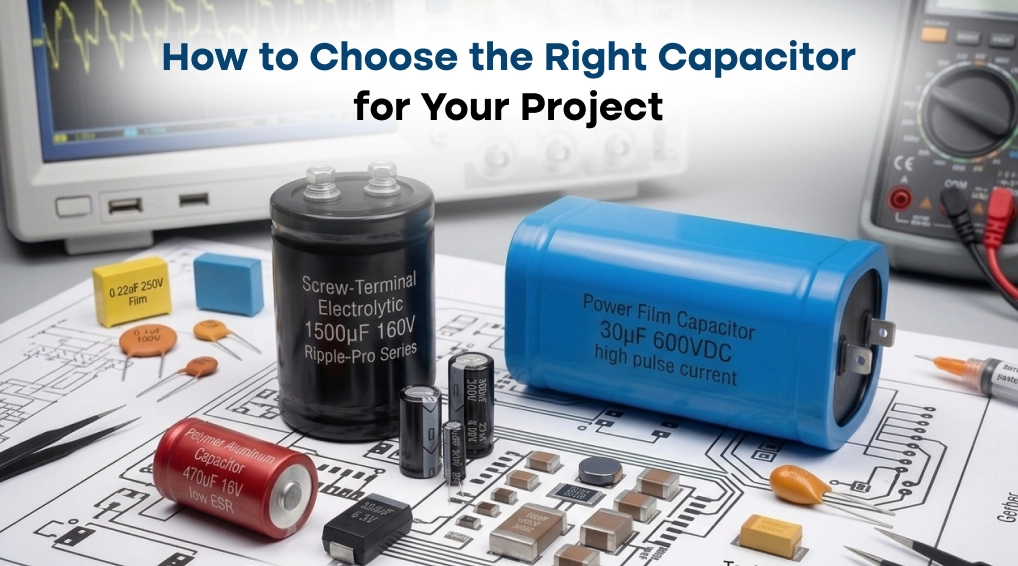
Choosing the right capacitor is one of the most important steps in any electronic design, repair job, or PCB assembly process. Many buyers know they need a capacitor, but they are often unsure which type, value, package, or voltage rating is actually right for their project.
Advancements in capacitor technology have greatly expanded the range of available options and applications, making careful selection even more important for modern electronic designs.
That confusion is common. A capacitor may look like a small part, but choosing the wrong one can affect filtering, signal stability, power performance, or even the reliability of the final product. Whether you are working on a compact PCB, a repair task, a prototype, or a production requirement, the right capacitor selection matters.
This capacitor buying guide explains how to choose the right capacitor in a simple and practical way.
Why Capacitor Selection Matters
Capacitors are essential passive components in electronic circuits, used across almost every electronic application. They help with power supply filtering, decoupling, signal coupling, timing, smoothing, and noise suppression by storing and releasing electrical energy as needed. But different circuits require different capacitor characteristics.
For example, one project may need a small ceramic capacitor for high-frequency stability, while another may need a tantalum capacitor for compact capacitance in a power-related section. The dielectric material inside a capacitor determines its ability to store and release electrical energy, which is fundamental to its function and affects properties like dielectric constant and dielectric losses. That is why selecting a capacitor only by price or size is not enough.
A better approach is to choose a capacitor based on application, capacitance value, voltage rating, polarity, mounting style, and package type.
Step 1: Start With the Capacitance Value
The first thing to check is the required capacitance value.
Capacitance is the main electrical property of the capacitor and is typically measured in:
- pF for very small values
- nF for medium-range values
- µF for higher values
Each capacitor has a rated capacitance, which is the nominal value specified by the manufacturer. However, the actual capacitance may vary due to manufacturing tolerances, and the exact capacitance can be critical in precision applications such as RF circuits or timing elements, where stability and accuracy are essential. In contrast, applications like decoupling may not require such pinpoint accuracy.
Tolerance is the allowed deviation from the nominal capacitance, often expressed as a percentage (e.g., ±5%, ±10%). Precision applications often require tighter tolerances such as ±5% to ensure the actual capacitance closely matches the rated value for optimal circuit performance.
If your design needs a small-value capacitor for signal or frequency-related work, a product like a 470 pF ceramic capacitor may be suitable. If your design needs higher capacitance for filtering or energy support, a 10 µF or 22 µF tantalum capacitor may be more appropriate.
Always match the capacitor value to your circuit requirement rather than choosing a random available part.
Step 2: Check the Voltage Rating
Voltage rating is one of the most important selection factors.
A capacitor must be able to handle the voltage present in your circuit. The rated voltage, also called the maximum voltage, is the highest voltage the capacitor can safely handle. The applied voltage in your circuit should never exceed the rated voltage; for safety and longevity, the voltage rating should be at least 1.5 to 2 times higher than the maximum expected operating voltage. This applies to both DC voltage and AC voltage applications, where careful consideration of voltage rating is essential. If the voltage rating is too low, the component may fail, become unreliable, or suffer damage from voltage spikes or voltage increases that can occur during operation.
For example:
- a 100V ceramic capacitor may be suitable in circuits where higher-rated small-value capacitors are needed
- a 25V tantalum capacitor may work well in compact electronic designs
- a 16V radial tantalum capacitor may be suitable for lower-voltage applications
Never ignore the voltage rating just because the capacitance value matches.
Step 3: Choose the Right Capacitor Type
One of the biggest parts of capacitor selection is understanding the different types of capacitors available. There are many capacitor types, including ceramic, tantalum, electrolytic, and film capacitors, each with unique characteristics and applications. Knowing the specific features and uses of these capacitor types is essential for choosing the right component for your circuit.
Ceramic Capacitors
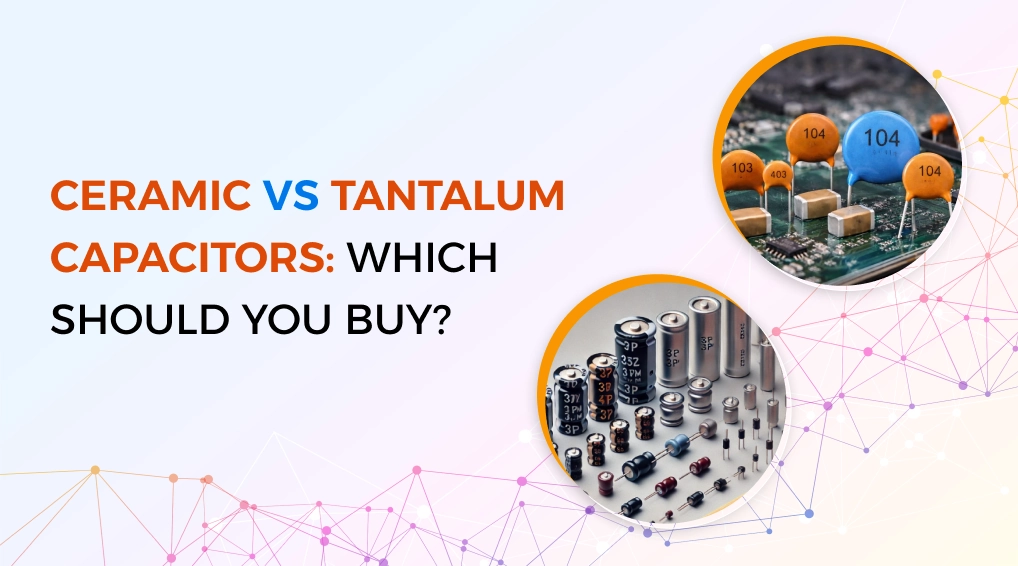
Ceramic capacitors are commonly used in modern electronics because they are compact, widely available, and suitable for many high-frequency and general-purpose applications. They are typically non-polarized, which makes them easier to use in many circuit positions.
Ceramic capacitors are widely used due to their small size, low cost, and excellent performance, making them ideal for high-frequency applications. Their capacitance rating and rated capacitance are important factors to consider, especially in signal and RF circuits, to ensure optimal performance.
Ceramic capacitors are often chosen for:
- decoupling
- bypassing
- filtering
- compact PCB layouts
- high-frequency circuits
A small 0805 ceramic capacitor is a practical choice for space-saving boards and many signal-related applications.
Tantalum Capacitors
Tantalum capacitors, more accurately known as tantalum electrolytic capacitors, are constructed using tantalum metal as the anode. This fundamental material enables a thin dielectric layer, resulting in high capacitance and reliable performance in a compact form factor. These capacitors are polarized, so correct installation direction is important. Tantalum electrolytic capacitors require a stable DC supply for safe operation and are sensitive to DC bias, which can affect their performance and reliability.
Tantalum capacitors are often chosen for:
- power rail support
- filtering
- compact energy storage
- industrial electronics
- portable electronics
A 22 µF 25V SMD tantalum capacitor can be useful in compact PCB designs, while a 10 µF 16V radial tantalum capacitor may be a better fit for through-hole work, repair, or prototyping.
Step 4: Understand Polarity Before You Buy
This step is essential.
Ceramic capacitors are generally non-polarized, so they are easier to place in many circuits. Electrolytic capacitors, including tantalum types, are polarized and must be connected with the correct polarity. This means you need to identify and connect the positive terminal and negative terminal properly; reversing polarity can damage the capacitor and affect the performance of the circuit.
So if your assembly process needs easier handling and orientation flexibility, ceramic capacitors may be more convenient. If you need the benefits of tantalum capacitors, make sure your design and assembly process properly account for polarity and ensure the positive terminal and negative terminal are correctly connected.
Step 5: Choose SMD or Through-Hole
Mounting style has a big impact on what capacitor you should buy. The physical size and package of the capacitor must fit the design of the circuit board, with surface-mount capacitors being more commonly used in modern electronic devices compared to through-hole types.
SMD Capacitors
Surface-mount capacitors are best for:
- modern PCB layouts
- compact products
- automated assembly
- production boards
- high-density designs
If your project uses modern compact PCBs, an 0805 ceramic capacitor or 2312 SMD tantalum capacitor may be the right fit.
Through-Hole or Radial Capacitors
Through-hole capacitors are better for:
- manual soldering
- breadboard-friendly or repair work
- prototyping
- educational electronics
- service and maintenance tasks
A radial tantalum capacitor is often a practical choice for these use cases.
Step 6: Match the Capacitor to the Application
The best capacitor is not the most expensive or the highest-rated one. It is the one that fits your actual application. Filtering applications and power supply circuits often require capacitors with large capacitance values to reduce voltage ripple and improve energy efficiency. When selecting a capacitor, it is important to prioritize capacitance value, rated voltage, operating temperature, and Equivalent Series Resistance (ESR) to ensure stability and longevity. High-frequency applications typically require smaller capacitance values, while energy storage and filtering applications benefit from larger capacitance values.
Here is a simple way to think about it:
For compact PCB and high-frequency work
A ceramic capacitor is often the better choice. Small packages like 0805 are suitable for dense layouts and general PCB use.
For power filtering and stable capacitance
A tantalum capacitor is often a strong option, especially when you need higher capacitance in a compact form. However, aluminum electrolytic capacitors are commonly used for power filtering in power supply circuits due to their large capacitance and high capacitance value. These aluminum electrolytic capacitors, a type of electrolytic capacitor, are known for their high capacitance, cost-effectiveness, and are widely used to smooth out voltage ripple. Capacitance values for smoothing power supplies commonly range from 470μF to 2200μF, making aluminum electrolytic capacitors ideal for bulk energy storage and filtering applications.
For prototyping and repair work
A radial or leaded tantalum capacitor may be easier to handle and solder than a small SMD part.
For general electronics projects
Choose based on the actual function in the circuit. Small-value ceramic capacitors and higher-value tantalum capacitors often serve very different purposes.
Step 7: Check Package Size Before Ordering
Many capacitor selection mistakes happen because the electrical value is correct but the package does not fit the board.
Always verify:
- package size
- footprint compatibility
- mounting type
- board space
- lead spacing for through-hole parts
For example:
- 0805 is a common SMD package for compact ceramic capacitors
- 2312 is a larger SMD package often used in tantalum capacitors
- radial leaded capacitors are useful in through-hole applications
If the package does not match your PCB or soldering method, the capacitor is not the right choice even if the value is correct.
Step 8: Think About Temperature and Stability
Some applications require better stability over temperature and operating conditions.
If your circuit is sensitive or operates in more demanding environments, capacitor characteristics such as dielectric type, operating temperature, and long-term stability become more important. The operating temperature range for industrial capacitors often extends from -40°C to +105°C, and capacitance can shift significantly with temperature changes, affecting performance.
Polyester film capacitors are known for their stability at higher temperatures, performing well up to 125°C, making them suitable for applications requiring stability at elevated temperatures. Polypropylene film capacitors, which use a thin plastic film as the dielectric, are valued for their excellent stability, low self-inductance, and are commonly used in audio, snubber circuits, and other high-performance applications.
For many compact signal and PCB designs, ceramic capacitors with stable dielectric behavior are a practical choice. For applications where stable capacitance in a compact body matters, tantalum capacitors are often preferred.
Common Mistakes Buyers Make
Many capacitor buying mistakes are easy to avoid.
- Failing to consider the equivalent series resistance (ESR) can lead to significant problems, especially in high-speed switching power supplies and high-current applications. Low ESR is critical in these scenarios to minimize energy loss and prevent overheating.
- Overlooking the self healing capability of some film capacitors can result in reduced reliability, as this feature helps maintain performance and safety during power surges or transient conditions.
- Not matching the voltage rating to the application can cause premature failure.
- Ignoring temperature ratings may lead to degraded performance or shorter lifespan.
- Choosing the wrong capacitance value can affect circuit timing or filtering effectiveness.
- Neglecting to check physical size and mounting style may result in installation issues.
Choosing only by capacitance
Two capacitors with the same capacitance may still behave very differently because of voltage rating, type, package, and polarity.
Ignoring voltage rating
A matched capacitance value is not enough if the voltage rating is too low.
Forgetting polarity
This is especially important with tantalum capacitors.
Ordering the wrong package
An 0805 part and a radial leaded part are not interchangeable on the same board design.
Using one capacitor type for every application
Different applications often require different capacitor characteristics.
A Simple Capacitor Selection Example
If you are working on a compact PCB where space is limited and the circuit needs a small capacitance value, a 470 pF 100V ceramic capacitor in 0805 package may be suitable.
If your design needs higher capacitance on a compact board for filtering or power support, a 22 µF 25V SMD tantalum capacitor may be a stronger choice.
If you are doing repair work, lab testing, or through-hole design, a 10 µF 16V radial tantalum capacitor may be more practical.
For applications requiring very high capacitance and the ability to release electrical energy quickly, such as starting motor engines or regenerative braking systems, supercapacitors are ideal due to their large energy storage and fast discharge capabilities.
Sample and hold circuits, which are used in analog signal processing and peak detection, require capacitors with low dielectric absorption to maintain signal accuracy.
This is why the right capacitor depends on where and how it will be used.
How to Choose the Right Capacitor for Beginners
If you are new to electronics, start with these questions:
- What capacitance value does the circuit require?
- What is the operating voltage?
- Does the board use SMD or through-hole components?
- Is polarity important?
- Is the capacitor for filtering, power, timing, or signal work?
- Does the board have size limitations?
Understanding different capacitor types and their unique characteristics will help you make better choices for your circuit board designs.
Once these are clear, selecting the right capacitor becomes much easier.
Final Thoughts
Learning how to choose the right capacitor helps you avoid common circuit and purchasing mistakes. It also helps you buy with more confidence, especially when working on PCB design, electronic repair, prototyping, or production requirements.
The best capacitor for your project depends on several factors, including capacitance, voltage rating, package type, polarity, mounting style, and application.
If you need a compact non-polarized option for many PCB uses, a ceramic capacitor may be the right fit. If you need stable capacitance in a compact package for power-related applications, a tantalum capacitor may be the better choice.
Selecting the perfect capacitor for your circuit design ensures optimal performance and reliability. Choosing carefully at the start saves time, reduces errors, and improves final circuit performance.
FAQs
How do I choose the right capacitor for my project?
Choose the right capacitor by checking capacitance value, voltage rating, package type, mounting style, polarity, and the actual use of the capacitor in the circuit.
What is the difference between ceramic and tantalum capacitors?
Ceramic capacitors are generally non-polarized and widely used for high-frequency and general PCB applications, while tantalum capacitors are polarized and often used where stable capacitance and compact size are important.
How do I select a capacitor voltage rating?
Select a capacitor with a voltage rating suitable for your circuit and preferably above the expected operating voltage for safer performance.
Which capacitor is better for PCB design?
Ceramic capacitors are often excellent for compact PCB layouts and signal-related applications, while tantalum capacitors are useful when higher capacitance in a compact package is needed.
Which capacitor is better for repair work?
For repair and through-hole applications, radial or leaded capacitors are often easier to use than very small SMD parts.
Can beginners use tantalum capacitors?
Yes, but they should carefully check polarity and voltage rating before installation.
Leave a Comment
Your email address will not be published. Required fields are marked *