
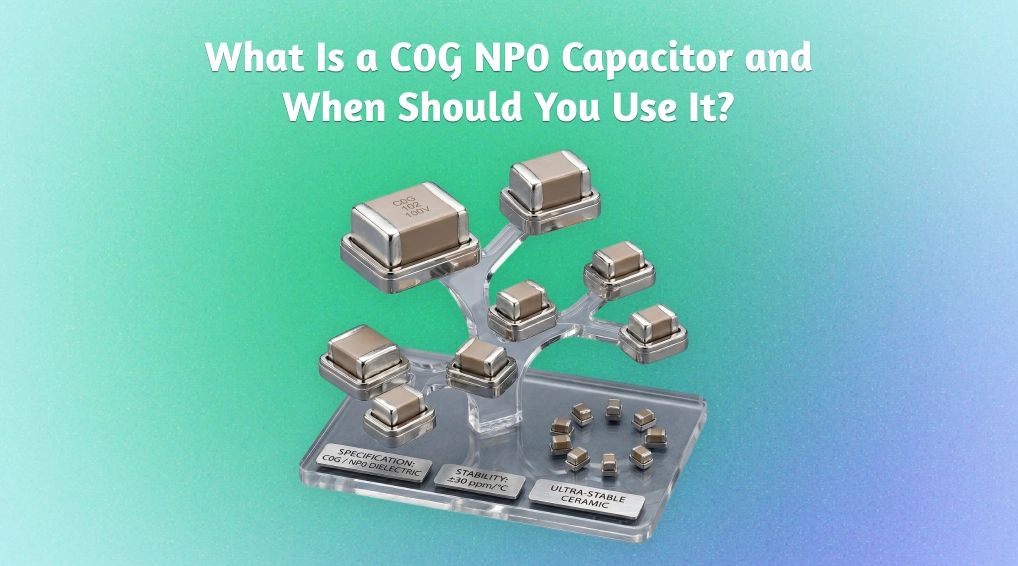
When buyers search for a ceramic capacitor, they often focus only on capacitance and voltage. But in many electronic designs, the dielectric type—specifically the dielectric material used—matters just as much as the value itself, since different materials directly affect capacitor performance characteristics. That is where C0G NP0 capacitors become important.
A C0G NP0 capacitor is known for its stability, low variation, and reliable performance across changing temperatures and operating conditions. If your project needs accuracy, consistency, or stable capacitance over time, this type of ceramic capacitor is often a much better choice than a general-purpose alternative, as C0G NP0 capacitors are passive components made using specialized materials formulated by manufacturers for high stability.
In this guide, we will explain what a C0G NP0 capacitor is, when you should use it, and why a 470pF 100V C0G NP0 0805 ceramic capacitor can be a strong option for compact PCB designs, making it a key choice among passive components for precision electronics.
What Is a C0G NP0 Capacitor?
A C0G NP0 capacitor is a type of ceramic capacitor that uses a highly stable Class I dielectric, which is known for its excellent stability and is further divided based on temperature characteristics. It is designed for applications where capacitance must remain consistent with changes in time, voltage, and temperature.
C0G (NP0) capacitors are classified as Class 1 dielectrics, which are ultra-stable with minimal capacitance variation due to temperature, voltage, or aging.
This is one of the biggest reasons engineers and serious electronics buyers choose C0G NP0 ceramic capacitors for precision-related work. These capacitors are not just small and PCB-friendly. They are also built for stability. They have a temperature coefficient of 0 ±30 ppm/°C, meaning their capacitance changes very little with temperature across a range of -55°C to +125°C.
In practical terms, a C0G NP0 capacitor is often chosen when a circuit cannot tolerate large capacitance drift, and they also feature high insulation resistance, which contributes to their reliability in precision circuits.
What Does C0G or NP0 Mean?
The terms C0G and NP0 refer to the temperature characteristics of the capacitor dielectric.
Codes like C0G and NP0 are standardized by the Electronic Industries Alliance (EIA) to indicate the dielectric type and temperature characteristics of ceramic capacitors.
In simple terms, they indicate that the capacitor has:
- very low temperature-related capacitance shift (the three-character code, such as C0G, describes the dielectric type and its temperature characteristics)
- excellent long-term stability
- very little change with applied voltage
- reliable behavior in sensitive circuits
For many buyers, this matters because some ceramic capacitors can change performance more noticeably under real operating conditions. A C0G NP0 capacitor is selected specifically to avoid that kind of instability.
Why C0G NP0 Capacitors Are Considered Stable
C0G NP0 capacitors are valued because they offer:
- minimal capacitance change over time
- negligible change with voltage
- excellent thermal stability
- low losses and high reliability
- predictable electrical performance
That makes them useful in circuits where capacitance accuracy matters.
C0G NP0 capacitors are not significantly affected by temperature, voltage, or aging, and do not experience a decrease or drop in capacitance over time.
A product like a 470pF 100V C0G NP0 capacitor is not just about size or voltage. It is about giving the circuit a stable component that performs consistently in real conditions, and is less prone to issues like drift or instability, making it ideal for sensitive applications. C0G capacitors exhibit negligible capacitance drift or hysteresis, with typical change over life being less than ±0.1%.
When Should You Use a C0G NP0 Capacitor?
A C0G NP0 ceramic capacitor is usually a good choice when your circuit needs stable and repeatable performance.
Common use cases include:
- resonant circuits
- timing-related sections
- frequency-sensitive applications
- filtering in precision circuits
- compact PCB designs
- high-stability signal applications
- high frequency circuits
- decoupling
- bypassing
- coupling
- energy storage
C0G capacitors are also used in crystal oscillator load circuits, timing networks, RF and microwave applications such as impedance matching and EMI suppression filters, high-fidelity audio circuits to avoid distortion and noise, and precision filters and analog chains where capacitance stability is critical.
These capacitors are especially useful where you do not want the capacitance to drift significantly as the environment changes.
Why C0G NP0 Capacitors Are Good for Resonant Circuits
Resonant circuits often require components with predictable and stable electrical behavior. If the capacitance changes too much, the circuit may no longer perform as intended.
That is why C0G NP0 capacitors are commonly preferred for resonant and frequency-related applications. Their stable dielectric behavior helps maintain more consistent circuit performance.
For buyers working on tuned designs, frequency-related PCB layouts, or accuracy-sensitive electronics, this is a major reason to choose C0G NP0 over a more general ceramic capacitor.
What Makes a 470pF 100V C0G NP0 0805 Capacitor Useful?
A 470pF 100V C0G NP0 0805 ceramic capacitor is useful because it combines several practical advantages in one product:
- 470pF capacitance for small-value circuit requirements
- 100V rating for designs that need suitable voltage tolerance
- C0G NP0 dielectric for stable performance
- 0805 package for compact PCB compatibility (packaging and physical size are important for space-constrained or compact designs)
- surface-mount design for modern electronic assembly
However, C0G dielectrics have lower permittivity than Class II materials, so they require a larger volume or physical size to achieve the same capacitance, which can impact space optimization in electronic designs.
Why 0805 Package Size Matters
Package size matters because the capacitor must fit your PCB layout.
The 0805 package is a common and practical SMD size used in many modern electronic designs. It offers a good balance between compact board use and manageable assembly.
An 0805 ceramic capacitor is often preferred when:
- board space is limited
- the design uses standard SMD footprints
- automated or modern PCB assembly is involved
- the part needs to fit a compact layout without becoming too difficult to handle
If your design already supports an 0805 footprint, choosing a matching 0805 C0G NP0 capacitor makes practical sense.
Why Voltage Rating Still Matters in Small-Value Capacitors
Some buyers assume that a small-value capacitor does not need much attention on voltage. That is a mistake.
Even for a 470pF ceramic capacitor, voltage rating matters because the capacitor must remain suitable for the circuit conditions. A 100V ceramic capacitor can be a strong choice where higher rated small-value components are required. C0G NP0 capacitors are immune to DC bias effects, maintaining stable capacitance even under high voltage, whereas Class II types like X7R and X5R can experience significant capacitance loss under DC bias.
Matching capacitance is only part of good component selection. Voltage rating must also be checked before ordering.
Compared to X7R and X5R, C0G NP0 capacitors offer superior stability and reliability, especially under varying voltage and temperature. While X7R and X5R provide higher capacitance values, they are less stable and more affected by voltage and temperature changes, making C0G NP0 preferable for precision applications.
Why C0G NP0 Capacitors Are Good for High-Frequency Applications
In many high-frequency and signal-related applications, stability matters more than simply using any available ceramic capacitor.
A C0G NP0 capacitor is useful here because it offers:
- low capacitance drift
- stable electrical behavior
- good reliability in compact PCB designs
- efficient performance with low losses
- better suitability for applications where accuracy matters
C0G MLCCs are ideal for onboard chargers (OBCs) in electric vehicles due to their extremely stable capacitance, which experiences near-zero change with temperature, voltage, or aging. In high-voltage applications, they offer reduced heat generation and improved transmission efficiency compared to traditional film capacitors.
That is why buyers looking for a high frequency ceramic capacitor often prefer C0G NP0 dielectric when the circuit needs dependable performance.
How Is a C0G NP0 Capacitor Different From a General Ceramic Capacitor?
Not every ceramic capacitor is designed for the same purpose. When making a comparison between Class I and Class II ceramic capacitors, it’s important to note that Class I types like C0G (NP0) offer superior stability and minimal variations in capacitance, temperature, and voltage, while Class II types such as X7R and Y5V can exhibit significant variations and less predictable performance.
A general ceramic capacitor may be suitable for many everyday applications, but if your design needs strong capacitance stability, a C0G NP0 ceramic capacitor is often the better choice.
The main advantage is not just that it is ceramic. The main advantage is that its dielectric behavior is much more stable in conditions where accuracy matters, providing benefits such as minimal capacitance change over temperature, low hysteresis, and reliable performance.
So if your project is sensitive to capacitance changes, choosing a C0G NP0 capacitor is a smarter buying decision.
Ceramic capacitors are categorized into two classes based on their dielectric materials: Class I, with C0G (NP0) being the most common, and Class II, with X7R and X5R as common examples.
Common Buying Mistakes to Avoid
Choosing only by capacitance
A 470pF capacitor is not always interchangeable with another 470pF capacitor if dielectric performance is different.
Ignoring dielectric type
For stable circuits, dielectric type can be just as important as value and voltage.
Ordering the wrong package
If your board uses 0805 footprint, the capacitor should match that package.
Overlooking voltage rating
Even small-value capacitors need an appropriate voltage rating.
Using a general-purpose capacitor in a precision circuit
If the application needs stability, a C0G NP0 capacitor is often the safer option.
A Simple Selection Example
Suppose you are designing a compact PCB that needs a stable small-value capacitor for a frequency-sensitive or signal-related section. In that case, a 470pF 100V C0G NP0 0805 capacitor can be a very practical choice because it gives you:
- stable capacitance behavior
- compact SMD compatibility
- good voltage margin
- suitability for circuits that value consistency
These capacitors are widely used in electronic systems to help maximize the range and efficiency of applications, especially in automotive or power electronics. C0G NP0 capacitors are widely available from major distributors like DigiKey, where buyers can check stock and specifications directly on the distributor’s website.
This makes it a strong option for electronics buyers who care about long-term reliability and stable circuit performance.
Is a C0G NP0 Capacitor Good for Beginners?
Yes, especially if the buyer wants to learn proper component selection rather than choosing parts only by value. Readers can also benefit from a technical course or guide on capacitor types to deepen their understanding.
For beginners, this is a good lesson: two capacitors can have the same capacitance but behave differently in real applications.
A C0G NP0 ceramic capacitor is a useful option when the goal is better stability, especially in PCB-based designs. C0G NP0 capacitors are less prone to age-related drift, making them a reliable choice for long-term use.
Final Thoughts
Understanding what a C0G NP0 capacitor is can help you make better buying decisions for PCB design, repair work, and precision electronics projects. These capacitors are valued because they offer strong stability, minimal drift, and dependable performance in applications where capacitance consistency matters. Advanced manufacturing processes and expanded dielectric formulations contribute to the stability and reliability of C0G NP0 capacitors.
A 470pF 100V C0G NP0 0805 ceramic capacitor is a practical example of this type of component. It combines stable dielectric performance, compact size, and a useful voltage rating for modern electronic designs, and technical figures or diagrams can help illustrate the differences between capacitor types and their key parameters.
If your project needs a reliable ceramic capacitor for high-stability or frequency-sensitive use, a C0G NP0 capacitor is often the right direction. Technical briefs or courses can provide further answers about dielectric materials, their formulations, and their applications.
FAQs
What is a C0G NP0 capacitor?
A C0G NP0 capacitor is a ceramic capacitor with a highly stable Class I dielectric, using materials with a stable dielectric constant to ensure minimal capacitance change with temperature, time, and voltage.
What is a C0G NP0 capacitor used for?
It is commonly used in resonant circuits, frequency-sensitive designs, filtering, and other applications where stable capacitance is important. For applications requiring higher capacitance with good temperature stability, expanded dielectric formulations such as U2J are used, offering increased capacitance levels while maintaining reliable performance.
Why is C0G NP0 better for stable circuits?
C0G NP0 capacitors are preferred for stable circuits because they show very low capacitance drift and are not significantly affected by temperature, voltage, or aging, meaning they do not experience a decrease in capacitance over time and provide reliable performance across operating conditions.
Is a 470pF 100V C0G NP0 0805 capacitor good for PCB design?
Yes, it is a good choice for compact PCB designs that need a stable small-value ceramic capacitor in an 0805 SMD package.
Why does dielectric type matter in ceramic capacitors?
Dielectric type matters because it affects how the capacitor behaves with temperature, voltage, and time. Different dielectric formulations result in variations in capacitance stability, temperature response, and voltage tolerance. For precision or stable applications, this is very important.
Is an 0805 C0G NP0 capacitor good for high-frequency applications?
Yes, it is often a suitable option for high-frequency and signal-related applications where stable capacitance is needed, as C0G NP0 capacitors offer low losses and are ideal for high frequency circuits and coupling applications.

Leave a Comment
Your email address will not be published. Required fields are marked *